
The Great Lakes region has come a long way since the 1990s in recovering from threats to peace and security of various kinds. Conflicts have considerably diminished in intensity and scope, thanks to the combined efforts of national, regional and international stakeholders.
However, current instability persists, due to root causes and unaddressed grievances, compounded by weak governance systems and perpetuated by socio-economic inequalities and external factors.
Challenges related to the extension of state authority to the eastern part of the Democratic Republic of the Congo (DRC) and its borders with Burundi, Rwanda and Uganda, creating a power vacuum exploited by non-state armed groups (NSAGs). Regional efforts are underway to ensure that military operations are effectively complemented by a regional approach involving joint action on comprehensive non-military measures. This will include supporting strengthened disarmament, demobilization and reintegration (DDR) and disarmament, demobilization and reintegration (DDR) disarmament, demobilization, repatriation, reintegration and resettlement (DDR/RR) programs at national and regional levels.
The region has suffered from complex situations caused by factors such as extremism, socio-economic exclusion, ethnic conflict, exclusion from access to land and resources, and marginalization. The Great Lakes region has seen an economic slowdown, rising poverty rates and rising costs of basic goods. Conflict and political instability in parts of the region have led to economic slowdown, rising poverty rates and rising commodity costs. Over the years, peace processes have made significant progress, with both governments in the region and international partners demonstrating a commitment to peace and security. While positive developments continue in all the countries of the Great Lakes region, the dynamics of conflict in the region are also becoming more difficult and complicated. Conflict dynamics in the region are complex, involving a multiplicity of interlocking actors. Violent conflicts have tended to spread geographically, and the epicenter of conflict shifts from one country to another, leading to the identification of regional approaches to the analysis and management of conflict and development throughout the region. The central objective of peacekeeping is the recognition that, for peacebuilding to take place, it must be locally owned and based on people-centred approaches.
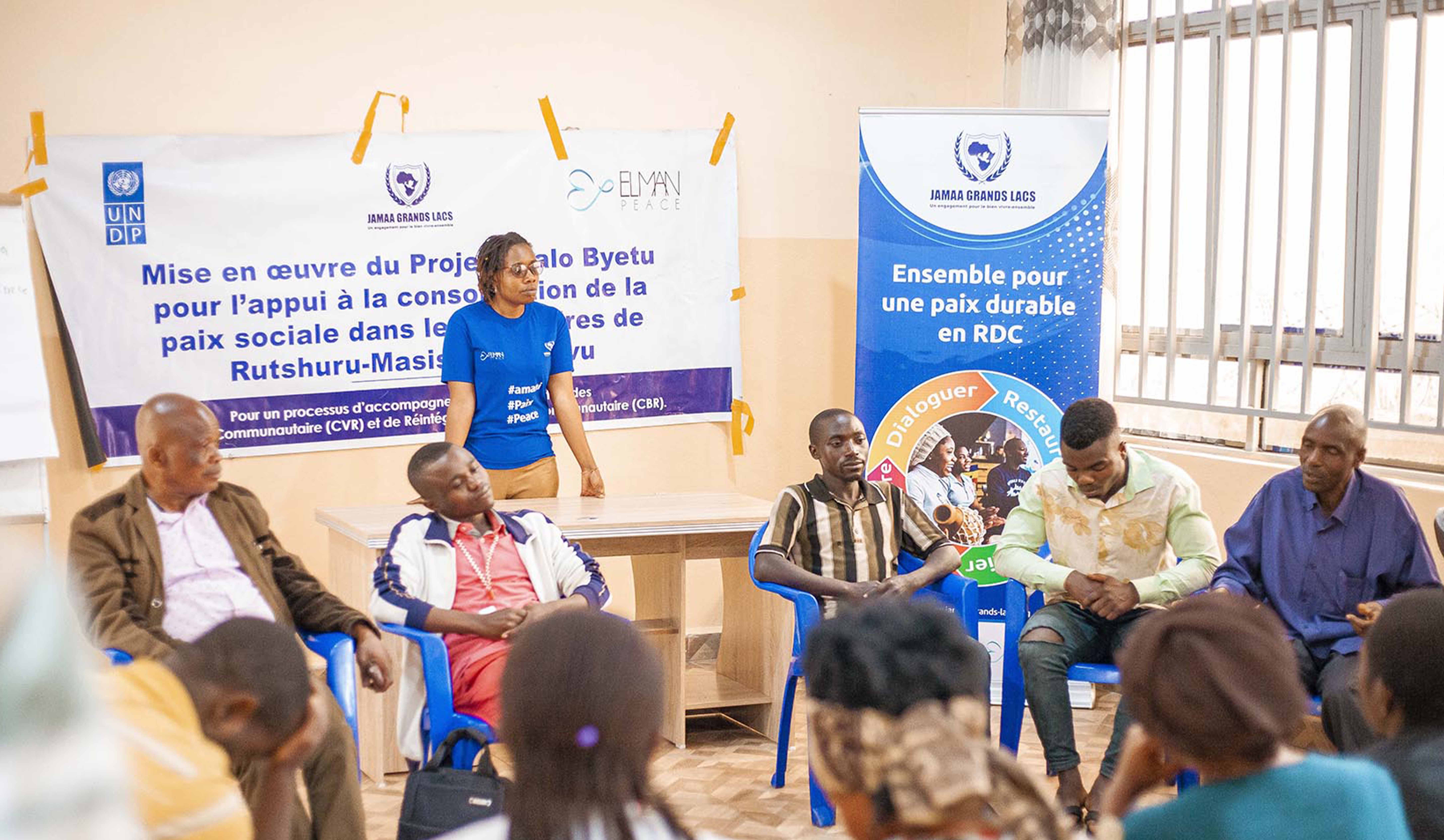
The Bilalo Byetu project implemented by JAMAA Grands Lacs, in partnership with Peace By Africa, Elman Peace, the CIRGL (International Conference on the Great Lakes Region) and the UNDP (United Nations Development Programme), has been an important initiative in the Great Lakes region, more specifically in the province of North Kivu, in the east of the Democratic Republic of Congo (DRC). This project was set up with the overall aim of enhancing the participation of civil society organizations (CSOs) and strengthening their capacity to act in reintegration, prevention of violent extremism (PVE) and inter-community mediation efforts.
Here are some of the efforts made by JAMAA Grands Lacs to achieve these goals:
Capacity building for mediators to intervene effectively in inter-community conflicts, based on traditional mediation methods, but also integrating more modern and structured approaches.
Reconciliation efforts were carried out through community meetings, discussion forums and intercultural activities, aimed at strengthening mutual understanding and promoting lasting peace between groups often in conflict.
Activities have been set up to give ex-combatants access to training and psychological support to overcome the traumas of war. Women ex-combatants, in particular, have been the focus of specific interventions to offer them opportunities for empowerment and integration into local development processes.